





This is not a question of whether African Spirituality exists. Its existence is not open for debate.
The real question is why some Africans have been conditioned to deny what has always been present, what has always governed, and what has always connected humanity to the Creator. There are many reasons for this denial, but the central one cannot be ignored. It is the impact of colonization and the system it established.
doubt anything originating from its own people.
This is not a question of whether African Spirituality exists. Its existence is not open for debate.
The real question is why some Africans have been conditioned to deny what has always been present, what has always governed, and what has always connected humanity to the Creator.
There are many reasons for this denial, but the central one cannot be ignored. It is the impact of colonization and the system it established.
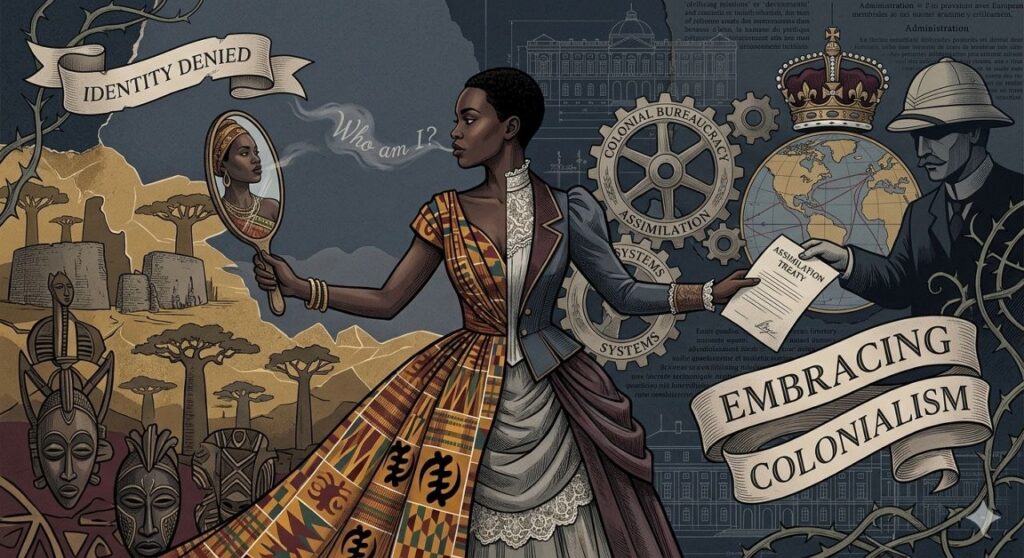
Colonization did not only take land or remove people from their physical spaces. It entered the mind and reshaped how Africans see themselves, how they see one another, and how they measure the truth.
Before this disruption, African Indigenous Spirituality operated as a complete system. It was not fragmented or informal. It was the Original System, what we understand as System A¹. It carried authority, governed knowledge, and stood as the Highest Office that connected the physical world to the Creator.
That system was deliberately interrupted.
Colonization introduced a different order. It replaced African spiritual authority with foreign systems and conditioned Africans to look outside of themselves for validation, knowledge, and truth. What remained was no longer the Original System. It became a disrupted condition, what we understand as the Intermediate System, or System B¹.
This is where divide and rule took its deepest form.
It did not only separate communities. It separated Africans from their own source. It created a condition where Africans no longer stand together in understanding, but stand apart in opposition. This can be seen in how easily Africans question one another, dismiss one another, and compete against one another, especially in matters of knowledge and spirituality.
When one African speaks, another African often becomes the first to challenge, not because the message is weak, but because the source is not trusted.
This is not natural behavior. It is learned. It is a condition produced by System B¹.
Religious Colonisation and the Control of the Mind
Religious colonisation stands as one of the deepest roots of divide and conquer because it operates at the level of faith and belief.
Other forms of control may shape behavior, but this form shapes perception. It determines what is accepted as truth and what is rejected without question.
Through religion, Africans were gradually conditioned to disregard what is African and spiritual. What once stood as truth within African Indigenous Spirituality was redefined, questioned, and eventually rejected. In its place came a system that requires belief rather than knowing.
The work of Maxwell Maltz helps to explain how this operates within the mind².
He explains that the human mind does not naturally distinguish between what is right and what is wrong. It responds to what it accepts as true. Once something is believed, the mind begins to organize itself around that belief.
This is the principle behind hypnotism.
The words of the hypnotist only become effective when they are accepted as truth. Once accepted, the mind begins to act accordingly. The power lies not in the words alone, but in the belief that those words are real.
This is how religious colonisation took root.
It introduced belief as the foundation and required faith as the method. Once these were accepted, the mind began to shift. What was once known became uncertain. What was once natural became questionable. What was once truth became something to be doubted.
This is why religion continues to promote belief.
Belief allows control at the level of perception. It allows different people to hold different realities based on what they accept as true. This is also why belief produces division. People see differently because they believe differently.
African Indigenous Spirituality operates differently.
It is not based on belief. It is based on knowing. It does not rely on faith in something unknown. It operates through revelation, where truth is experienced directly and understood beyond doubt.
This is why spirit was suppressed.
A system grounded in knowing cannot easily be controlled through belief. A system rooted in truth cannot be replaced by perception. For such a system to be removed, it had to be disrupted, and the people had to be shifted away from knowing into believing.
Once that shift took place, division followed.
The Slave Sees Slave Condition
What we see today is not accidental. It is the continuation of that process.
There was a time when Africans were collectively placed in a position of slavery, while the white race was positioned as the source of authority, knowledge, and structure. In that system, a slave was not expected to lead, teach, or carry wisdom. Authority was always external.
That structure may have changed physically, but it did not leave the mind.
Today, many Africans still look at one another through that same lens. When they see a fellow African, they do not immediately recognize authority or expect wisdom. There is an underlying assumption that nothing of higher value can come from someone who shares the same historical position.
So when truth is spoken, it is resisted.
Not because it is incorrect, but because of who is speaking.
At the same time, the same message, when it comes from outside, is more easily accepted. It is given weight and taken seriously.
This is how the condition sustains itself.
It is not enforced physically. It is maintained through perception.
This is why African Spirituality is often denied.
The denial does not always appear openly. Sometimes it is direct. Sometimes it is subtle. It may appear as reduction to culture or tradition, or as rejection through religious interpretation.
In each case, the outcome is the same. African Indigenous Spirituality is removed from its position as the Original System and placed beneath other systems that now claim authority.
What makes this more complex is that the denial often comes from Africans themselves.
This must be understood clearly.
The issue is not the absence of African Indigenous Spirituality. The issue is not that it lacks truth. The issue is the condition through which it is being viewed.
A person shaped by System B¹ will struggle to recognize System A¹. A person conditioned to look outside for authority will struggle to recognize authority within.
This is why the denial continues.
Until this psychological structure is broken, Africans will continue to oppose one another in ways that weaken collective understanding. They will continue to reject what comes from within while accepting what comes from outside.
As long as this continues, African Indigenous Spirituality will remain misunderstood, not because it is unclear, but because it is being viewed through a disrupted system.
The task is not to create African Indigenous Spirituality.
The task is to restore the ability to see it.
This is where the movement toward restoration begins. This is the transition toward System C¹.
System C is the return of what has always existed. It is the restoration of authority and the reestablishment of the connection between the Creator, the Highest Office, and the physical world.
That restoration cannot take place while Africans continue to deny what is already present.
The truth has never been absent.
What has been disrupted is the ability to recognize it.





This article provides a necessary roadmap for understanding the transition from System A to System C. It’s sobering to realize that System B, the ‘Intermediate System’ was specifically designed to make us doubt our own source and compete with one another. The idea that we challenge a message not because it is weak, but because the source is African, is a hard truth we must confront. Moving toward System C isn’t just about ‘tradition’; it is the radical act of restoring our ability to recognize authority within ourselves and our own people. A vital read for anyone serious about mental and spiritual decolonization.