





Those who are now breaking away from religious systems can be understood as rebels. They have recognized that what was presented to them as divine authority was not what it claimed to be. They have stepped out of systems that positioned themselves as the voice of the Creator, yet failed to reflect the truth. However, this awakening does not lead all of them to the same place, instead, It divides them.
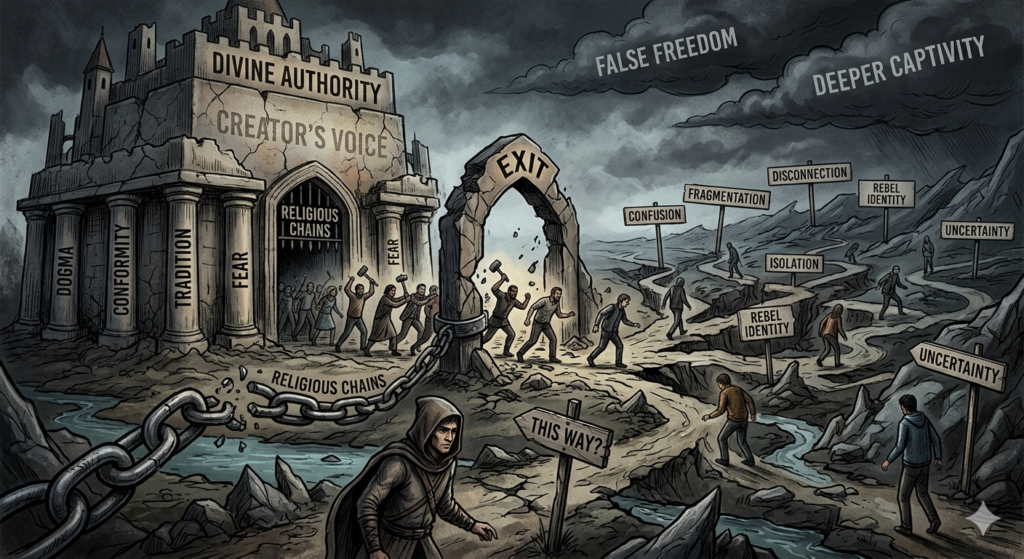
Illustration created by Gemini.
Freedom is often spoken about as if it is a single moment, a breaking away from something that once held power. Many today believe that once they have left religion, they have become free.
Yet this assumption does not fully explain what is taking place.
If freedom were simply the act of leaving, then clarity would follow. But what we see instead is confusion, fragmentation, and in many cases, a deeper form of disconnection. This suggests that what is being experienced is not complete freedom, but a transition into something else.
What appears as liberation begins to reveal itself, when examined closely, as a different form of captivity.
Those who are now breaking away from religious systems can be understood as rebels. They have recognized that what was presented to them as divine authority was not what it claimed to be. They have stepped out of systems that positioned themselves as the voice of the Creator, yet failed to reflect the truth.
However, this awakening does not lead all of them to the same place, instead, It divides them.
The First Group: The Seeking Rebels
The first group consists of those who have seen through the structure of religion, yet have not abandoned the understanding that there is a Supreme Being.
They recognize that religion, as it was presented, was not sanctioned by the Creator. They have freed themselves from its control, yet they have not rejected the existence of higher authority. They understand that there are Physical Spiritual Central Beings (PSCBs), a term I revealed to define the authentic spiritual guiders and leaders within their ranks of authority, who are chosen and positioned within a greater spiritual order, both here on earth and within the spiritual dimensions.
Their position is not one of rejection, but of search.
They are no longer bound, yet they are not fully grounded. Their challenge is no longer to escape, but to find the Divine truth that exists beyond the distortion they have left behind.
They stand in a transitional space. They have moved away from false structure, yet they have not fully reconnected with the restored and revealed Original System.
The Second Group: The Displaced Rebels
The second group reflects a different condition.
These are individuals who have not only left religion, but have been deeply affected by it. Their experience was shaped by fear, by control, and by a form of authority that presented itself as divine while operating through confusion and contradiction.
What was imposed on them did not bring clarity. It brought trauma.
In breaking away, they did not simply reject religion but they rejected hierarchy itself.
This is where the imbalance begins.
The rejection of religious authority extends into a rejection of hierarchy. Any concept that resembles order, structure, or spiritual positioning is viewed with suspicion. The idea of Physical Spiritual Central Beings becomes unacceptable, not because it lacks the truth, but because it reminds them of what they experienced.
In this state, new concepts begin to emerge.
The Turn Toward the “Universe”
One of the most common alternatives is the idea of the universe as the central force.
At surface level, this concept appears to offer freedom. It removes authority and hierarchical structure. It replaces hierarchy with energy and personal alignment. It suggests that what one attracts is based on what one embodies.
Yet when examined closely, this concept does not provide full answers.
It explains interaction, but not origin. It speaks of energy, but does not define its source. It offers a framework for experience, but not a foundation for existence.
It removes the question of authority, but in doing so, it leaves a gap.
The question of creation remains unanswered.
The “I Am God” Position
Alongside this is another position that has gained prominence. The idea that the individual is God.
At first, this appears to be the highest form of empowerment. It removes all external authority and places ultimate power within “the self.”
But this position requires deeper examination.
When we define what The Creator represents, we refer to a being without limitation, without dependency, and without contradiction. The highest Spiritual being or entity that is complete in authority and existence.
A human being does not fit this description.
Human existence is marked by limitation. It is shaped by learning, by error, and by dependence on systems beyond itself. Even the most advanced individuals do not operate without constraint.
This raises a necessary question.
Why does this concept exist?
When observed closely, it reveals a reaction.
It is not only about empowerment. It is about resistance. It is a rejection of hierarchy, driven by the desire to avoid being placed beneath any form of authority. It is an attempt to resolve past imposition by removing structure entirely.
Yet in doing so, it creates another form of imbalance.
The Question of Hierarchy
Hierarchy is often misunderstood because it has been misrepresented.
What many reject is not hierarchy itself, but the distortion of it.
Hierarchy is not a human invention. It is a spiritual principle. It is the structure through which order is maintained. It defines position, function, and flow within a system.
Without hierarchy, there is no coordination. Without coordination, there is no stability.
This is not only seen in spiritual systems. It is reflected in all forms of existence. Even human systems, in their attempt to create order, borrow from this principle, often without recognizing its origin.
The rejection of hierarchy, therefore, is not a movement toward freedom.
It is a movement away from order.
False Freedom
What we are witnessing is not complete liberation.
It is a condition that can be described as false freedom.
The first group has broken away, but is still seeking alignment. The second group has broken away, but has moved into rejection of structure itself.
Both groups have left religion, but neither has fully returned to the Original System.
This is the condition of the Intermediate System.
It removes the false structure, but does not restore the true one. It creates space, but does not fill it with clarity.
As a result, what appears as freedom is, in reality, a state of disconnection.
Toward True Freedom
True freedom is not found in the absence of structure.
It is found in the restoration of the correct structure.
It is not found in rejecting authority.
It is found in recognizing rightful authority.
It is not found in belief alone.
It is found in knowing.
This is where the return to the Original System becomes necessary. A system where hierarchy is not imposed, but understood. Where authority is not claimed, but revealed. Where connection to the Creator is not assumed, but established through truth.
Not all who have left are free.
Some have only moved from one form of control to another.
Freedom is not the rejection of structure.
Freedom is the restoration of truth.
Nevertheless, this is where reality must be confronted. Africa continues to reject African Indigenous Spirituality even when it presents itself through authentic spiritual guidance, through revelation, and through rightful spiritual authority that exists to direct humanity onto the correct path.
Yet it is this very authority, grounded in hierarchy, that is rejected by the African person.
This rejection is not without consequence. It attempts to reshape African Indigenous Spirituality into something it has never been. It reduces it into a form that appears without structure, without order, and without authority. In doing so, it strips it of the very foundation that establishes standards of practice within its cosmic existence.
What is being rejected is not disorder, but order itself. What is being resisted is not control, but alignment.
And in that rejection, the distortion of African Indigenous Spirituality continues.




The article presents a sophisticated critique of modern spiritual “deconstruction,” suggesting that the act of leaving organized religion is often mistaken for the destination of freedom, rather than a volatile transition period. It posits that many who break away fall into a state of “False Freedom,” where they trade the rigid walls of dogma for a fragmented landscape of confusion and isolation. The text argues that true liberation is not found in the total absence of structure, but in the restoration of what it calls the “Original System”—a framework where authority is not imposed through fear but revealed through truth.
Ultimately, the takeaway is a call to move beyond the identity of a “rebel.” The article suggests that while breaking chains is a necessary act of awakening, it must be followed by a conscious return to a structured spiritual reality. It challenges the reader to distinguish between “control,” which is a human imposition, and “alignment,” which is a spiritual necessity. In this view, freedom is not the power to be one’s own God, but the clarity to recognize and position oneself within a greater, authentic spiritual hierarchy.
What is being resisted is not control, but alignment.
These words are very powerful 🎯💯.